

Table of Contents
- What Grounding Techniques Actually Do for a Stressed Brain
- The 3-3-3 Rule for Anxiety: A 60-Second Reset
- Sensory Grounding Exercises for Work You Can Do at Your Desk
- Root Chakra Grounding Benefits for People Under Constant Pressure
- Micro-Grounding for High-Stakes Meetings
- Building a Daily Grounding Routine for Burnout Recovery
- Post-Stress Recovery: What to Do After the Crisis Passes
- Frequently Asked Questions
Last Updated: September 25, 2026
What Grounding Techniques Actually Do for a Stressed Brain
Grounding techniques for high stress jobs are simple, physical actions that pull your attention back to the present moment when pressure spikes. They work because they interrupt the loop of anxious thoughts and give your nervous system something concrete to process instead.
At Resonance Wellness with Julia, we see this play out daily: people who cannot sit through a meeting without their mind racing find that one small sensory anchor changes everything.
Grounding is the practice of redirecting attention to your physical body and immediate surroundings during moments of stress. It is not about emptying your mind or pretending the pressure is not there.
Here is what most guides get wrong. They treat grounding like a relaxation hobby. In reality, it is a stress management skill, and like any skill it gets stronger with repetition.
The methods below take under two minutes each. You can use them at a desk, in a hallway, or mid-conversation.
The 3-3-3 Rule for Anxiety: A 60-Second Reset
The 3-3-3 rule for anxiety is a quick grounding method: name three things you can see, three sounds you can hear, and three body parts you can move. It takes about a minute and needs no equipment.
Here is how to run it:
- Look around and name three objects you can see right now
- Listen and name three sounds, near or far
- Move three body parts: roll your ankles, flex your fingers, shrug your shoulders
That is it. The sequence floods your brain with sensory input, which crowds out the spiral.
Why the 3-3-3 Rule Works When Other Techniques Do Not
Most grounding advice tells you to "focus on your breath." That fails under acute stress because breathing is internal and easy to override with thoughts. The 3-3-3 rule works differently: it forces your attention outward, into the room, and then back into your body. You cannot silently argue with the sound of a printer or the weight of your own feet.
The three-step structure also gives your working memory a job.
The 3-3-3 Rule at Work: Three Variations for Different Settings
The basic version works anywhere, but high-stress jobs call for adaptations:
- Open office: Use sight and sound only. Naming three objects and three sounds is invisible. Skip the movement step if you are in a meeting.
- Video call: Keep your camera on and do the movement step below the frame. Roll your ankles, flex your toes, press your feet into the floor. No one sees it.
- Phone call: Stand up if you can. Walk to a window. Name three things you see outside, three sounds on the line or in the room, and move three body parts as you listen.
Common Mistakes That Kill the Effect
A common mistake is rushing it. Slow down and actually look at each object. The point is not to finish the list. The point is to notice.
Sensory Grounding Exercises for Work You Can Do at Your Desk
Sensory grounding exercises for work use touch, temperature, and smell to bring you back to the present moment. They are discreet enough to do in an open office without anyone noticing.
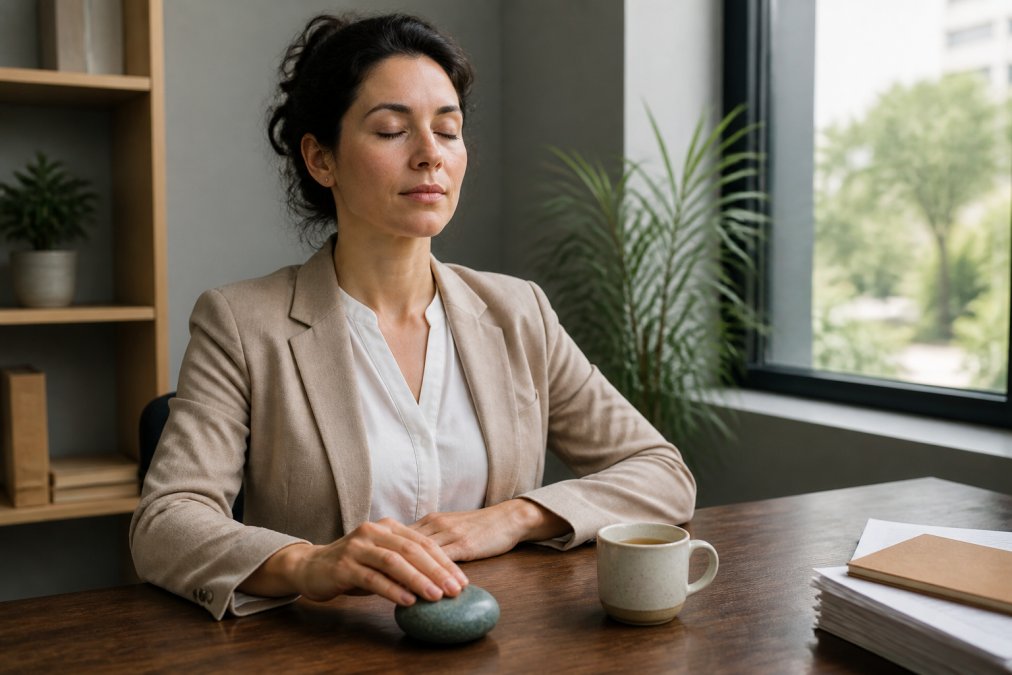
Try these at your desk:
- Temperature: Hold a cold glass of water or press cool fingertips to your wrists
- Texture: Run your thumb along the edge of your notebook or a fabric seam
- Weight: Press both feet flat into the floor and notice the pressure
- Scent: Breathe slowly near something with a familiar, calming smell
Root Chakra Grounding Benefits for People Under Constant Pressure
Root chakra grounding benefits center on stability: a felt sense of being supported when everything feels unsteady. Many people find that root-focused practices reduce the scattered, unanchored feeling that builds during long work weeks.
Resonance Rituals | Chakra 3 oz Candle →

What the Root Chakra Represents in Grounding Practice
In chakra-based traditions, the root chakra sits at the base of the spine and governs your sense of safety, stability, and belonging. When people describe feeling "unmoored" or "scattered" during a brutal work stretch, that is the language of a root chakra out of balance. Whether you read that literally or as metaphor, the practical takeaway is the same: the body needs a signal that it is supported before the mind can settle.
Why Root-Focused Practices Help Under Sustained Pressure
Acute stress triggers a fight-or-flight response that is designed to resolve quickly. Chronic work stress does not resolve. It lingers, keeping cortisol and adrenaline elevated for hours or days. Root-focused grounding practices work by giving the nervous system repeated, small signals of safety, which over time can help downshift that sustained activation.
Simple Root-Focused Practices for a Workday
You do not need a long ritual. These take under five minutes:
- Standing barefoot: If you work from home, stand barefoot on the floor for two minutes and feel your weight settle into your heels. If you are in an office, press both feet flat into the floor and notice the pressure.
- Extended exhale breathing: Inhale for a count of four, exhale for a count of six or eight. Repeat five times. The longer exhale is what triggers the calming response.
- Scent anchor: Light a candle, apply a familiar lotion, or breathe near a scent you associate with calm. Do it at the same time each day so the smell becomes a cue.
- Weighted contact: Hold a warm mug, rest your hands on your desk, or place a hand on your chest. Physical weight and warmth signal safety.
Building a Root Chakra Ritual That Fits a High-Stress Job
The most effective root-focused practice is one you will actually repeat. Pick a single time of day, ideally right after work or before bed, and do the same short sequence each time. The repetition is what trains your nervous system to associate the ritual with the transition out of work mode.
Micro-Grounding for High-Stakes Meetings
Micro-grounding is a 10-to-20 second grounding action you take in the moment, without leaving the room. It is built for presentations, negotiations, and performance reviews, the moments where you cannot step away but your heart rate is climbing.
Here is what to do instead:
- Before you speak, press your feet into the floor and exhale slowly
- While someone else talks, notice one physical sensation, like your hands on the table
- If your voice shakes, pause and take one slow breath before continuing
Building a Daily Grounding Routine for Burnout Recovery
A daily grounding routine for burnout works best when it is small and repeatable, not long and ambitious. The research on habit formation is clear: consistency beats intensity.
Here is a simple structure to build:
Time of Day |
Practice |
Minutes |
|---|---|---|
Morning |
Slow breathing before checking your phone |
3 |
Midday |
3-3-3 rule at your desk |
1 |
After work |
Candle ritual or a short walk |
5-10 |
Before bed |
Body scan or gentle stretching |
5 |
Post-Stress Recovery: What to Do After the Crisis Passes
A simple recovery protocol:
- Discharge: Take a two-minute walk or shake out your hands
- Downshift: Do five slow breaths with a long exhale
- Reset: Change your physical setting, even briefly, like stepping outside
- Reflect: Name one thing that went well, out loud or in writing
If you want a ritual to close out hard days, a candle lit at the same time each evening can serve as that signal. Resonance Wellness with Julia makes Reiki-infused chakra candles for exactly this kind of intentional pause.
Frequently Asked Questions
What is the 3-3-3 rule for grounding?
The 3-3-3 rule is a quick sensory grounding technique: name three things you can see, three things you can hear, and three things you can move or touch. It works because it pulls your attention away from anxious thoughts and back to the present moment through sensory input. You can do it in under a minute, which makes it useful during meetings, before a presentation, or any time workplace pressure spikes and you need to reset fast.
How do sensory grounding exercises for work help with anxiety during the day?
Sensory grounding exercises for work interrupt the loop of anxious thoughts by giving your brain concrete physical input to process. Simple actions like pressing your feet into the floor, holding a cool glass of water, or noticing the texture of your clothing activate physical awareness and calm the autonomic nervous system. Because they require no special equipment and draw no attention from coworkers, they fit easily into a busy workday without anyone noticing.
What are the root chakra grounding benefits for someone in a high stress job?
Root chakra grounding benefits center on stability and a sense of safety. In practice, that means feeling less thrown off by sudden deadlines, difficult conversations, or shifting priorities. Practices that support root chakra grounding, such as standing barefoot, slow breathing, or working with a Reiki-infused candle during a wind-down ritual, give your nervous system a consistent anchor. Over time, this builds emotional regulation and helps you respond to workplace pressure instead of reacting to it.
How long does a daily grounding routine for burnout take to show results?
Most people notice a shift in how they handle stress within the first week of a consistent daily grounding routine for burnout. The key is repetition, not duration. Even five minutes of intentional practice each morning or evening, whether that is deep breathing, a body scan, or lighting a candle and sitting quietly, trains your nervous system to settle faster. The longer you practice, the quicker your body returns to calm after a stressful event.
0 comments